
The idea of working fewer hours without lacking creativity has been discussed for decades, but 2025 feels different. For the first time, companies, employees, and global experts agree on one thing: AI is reshaping the way we work, and a shorter workweek is becoming more realistic than ever.
A growing number of companies, from startups to worldwide enterprises, are experimenting with a 4-day workweek, and many early results show promising improvements in productivity, employee well being, and overall proficiency. At the center of this shift is the AI-driven reduced workweek, a model where automation, intelligent systems, and smarter workflows make fewer work hours possible without sacrificing output.
The team TechEmplify makes massive research and explores how AI is creating the conditions for a sustainable 4-day workweek, why 2026 is the turning point, what benefits companies are seeing, and what challenges still need improvement.
Why 2026 Is the Tipping Point for the AI-Driven Reduced Workweek

Across the blogs and expert discussions trending today, there is a shared theme:
AI is now advanced enough to cut down workloads meaningfully, automate routine tasks, and help teams produce more with less time.
Several factors make 2026 different:
1. AI is finally practical for everyday tasks
Firms are no longer using AI only for specialized work. Now it supports daily tasks like:
- Data entry
- Report generation
- Writing summaries
- Inbox management
- Meeting notes
- Research
- Scheduling and coordination
These efficiencies add up, freeing hours every week.
2. Startups are proving shorter weeks work
As highlighted in the MAccelerator analysis, startups are the real testing ground. Many small teams implemented 4-day weeks after adopting AI tools that automate CRM, reporting, content generation, and customer support workflows. The results showed:
- Faster output
- Better focus
- Improved creativity
- Consistent delivery even with few working hours
3. Major business leaders support the shift
Fortune’s report highlights how influential tech leaders believe AI will keep automating routine tasks. Some predict a future where work itself becomes optional, but in the near term, it translates into reduced work hours.
4. Worldwide Discussion is Picking Up Pace
Reports from WEF and similar organizations show a growing focus on labor transformation, job redesign, future skills, and sustainable work structures. This makes the 4-day week a mainstream discussion, not a niche experiment.
How AI Is Enabling a Reduced Workweek

To understand the AI-driven reduced workweek, we need to look at how AI manages work that previously required human time and attention.
Here are the most impactful areas:
1. Automation of Repetitive Work
Repetitive tasks are the biggest opportunity. AI can now manage large portions of work that used to consume hours:
- Updating spreadsheets
- Creating routine reports
- Summarizing meetings
- Drafting basic emails
- Categorizing support requests
- Managing calendars
When these tasks disappear, employees can focus on high value work.
2. Smarter Workflows and Fewer Meetings
Many companies testing 4-day weeks discovered that meetings were the biggest time-wasters. AI tools now help with:
- Automatic meeting summaries
- Agenda creation
- Task extraction
- Replacing long meetings with short AI generated updates
With fewer internal meetings, the week becomes more productive even with reduced hours.
3. Better Task Management and Prioritization
AI-driven project management tools analyze:
- deadlines
- dependencies
- workload patterns
- team capacity
This helps teams focus on tasks that actually need attention, creating more output in less time.
4. Enhanced Creativity and Deep Work
Once repetitive tasks are automated, employees have more time for:
- strategy
- Problem solving
- innovation
- creative thinking
This is the kind of work AI enhances, not replaces.
5. Continuous Productivity Tracking
Some companies from the 4-day trials found that using AI-driven analytics helps track workflow efficiency in current time.
This ensures teams remain productive without increasing working hours.
Real World Proof That AI Supports a Shorter Week
-
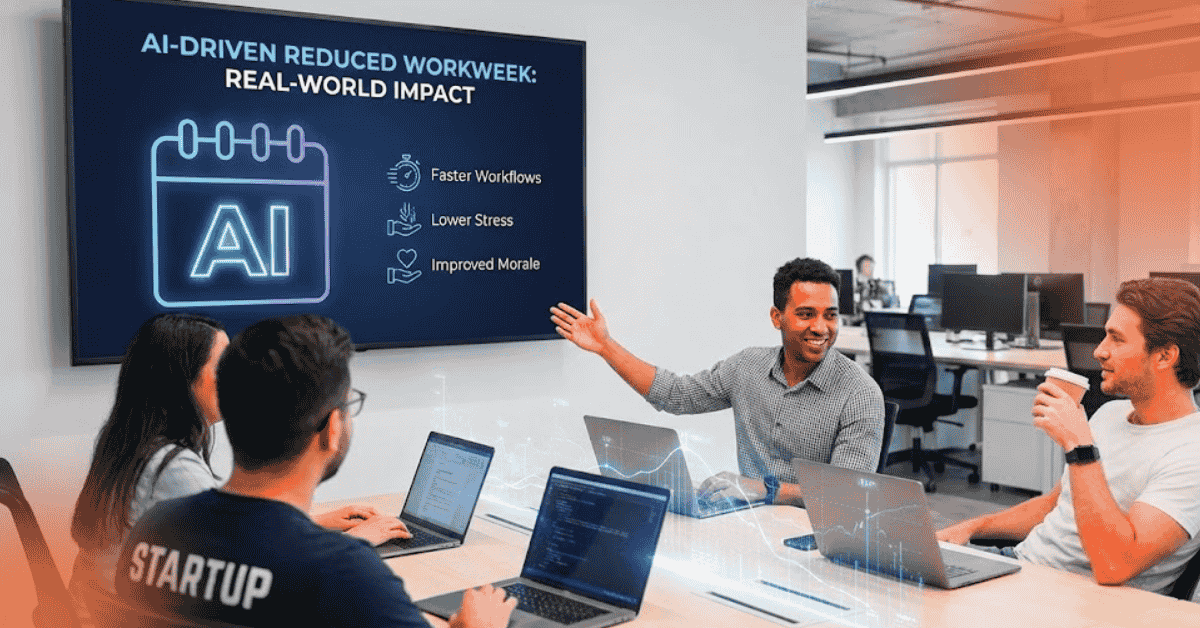
Startups adopting AI see faster workflows
Smaller companies using AI in documentation, CRM, communication, and automation are reporting equal or higher output in 32-hour weeks.
-
Employees perform better with less burnout
Early trials show:
- lower stress
- better focus
- improved morale
- higher job satisfaction
A rested employee produces more in four days than a burnt-out one produces in five.
-
Executives see AI as the catalyst
Experts are acknowledging that AI is accelerating productivity to levels that support reduced hours.
-
Global interest is rising
Reports on changing job skills, workforce structure, and new employer expectations show a worldwide conversation around reduced workweeks.
Why the AI-Driven Reduced Workweek Works for Businesses
1. Higher Productivity Per Hour
Across trials, companies saw:
- better focus
- faster completion times
- reduced distractions
- clearer priorities
Output per hour increases, even if total hours decrease.
2. Better Employee Retention
A shorter week is one of the most powerful retention tools.
Employees stay longer, companies save on hiring costs, and workplace culture improves.
3. Lower Burnout = Better Performance
Employees who get more rest come back more energized. A number of studies in the top blogs confirm this.
4. Improved Recruitment
A 4-day workweek is a major competitive advantage in hiring, especially in tech, marketing, finance, and creative industries.
5. AI Adoption Becomes Easier
When employees see that AI tools reduce their workload and give them more personal time, they are more open to using them.
Challenges Companies Must Consider
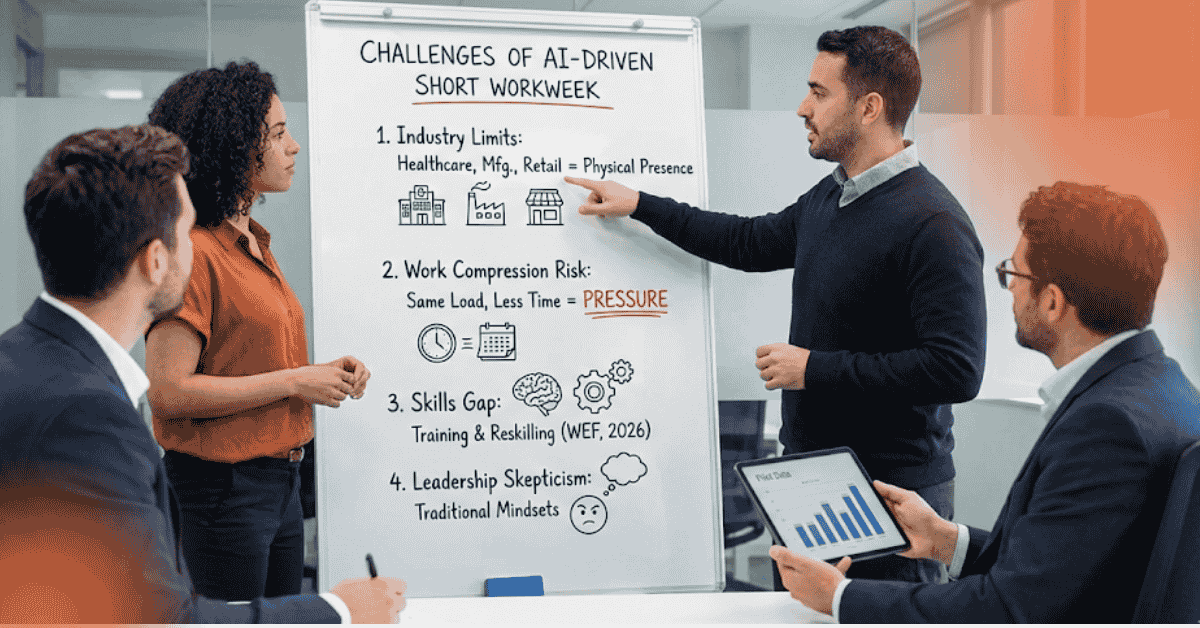
Experts are talking about key challenges we must acknowledge to keep the information balanced:
1. Not All Industries Can Reduce Hours
Healthcare, manufacturing, logistics, retail, and public services still require physical presence.
AI may help, but these industries can not reduce hours as easily.
2. Risk of Compressing More Work into Fewer Days
Some companies fear that a shorter week may mean:
- same workload
- less time
- increased pressure
This only works if businesses redesign, not compress work.
3. Skills Gap and Training Needs
Employees need training to adapt to AI tools.
WEF emphasizes the need for new skill development in 2026 and beyond.
4. Leadership Resistance
Some experts are still skeptical, especially in traditional industries. Clear data and pilot programs can help.
How Companies Can Successfully Move Toward a 4-Day Week
Here is a practical roadmap based on what successful companies have done:
Step 1: Identify Repetitive Tasks That AI Can Handle
Start with automation and process cleanup.
Step 2: Test AI Tools in Workflows
Try AI for:
- writing support
- reporting
- emails
- task management
- customer support
Step 3: Redesign Meetings
Cut meeting time by 40% to 60%.
Use AI for summaries and updates.
Step 4: Create a 4-Day Pilot Program
Run a 2 to 3 month test with:
- clear goals
- fixed metrics
- weekly feedback loops
Step 5: Measure Output, Not Hours
Companies that succeed focus on outcomes, not time spent.
Step 6: Improve Work Life Balance
Encourage mental breaks, flexible hours, and focus on deep work.
The Future of Work: What AI Means for the Long Term
Some experts believe the future could be zero work weeks.
Others think we will move step by step:
40 hours → 35 hours → 32 hours → flexible schedules
Whatever the path, AI is shaping the future of work by:
- reducing repetitive labor
- improving productivity
- enabling smarter workplaces
- creating space for creative and strategic thinking
The AI-driven reduced workweek is not a dream.It’s happening, and 2026 is the beginning.
Final Thoughts
The AI-driven reduced workweek represents a major shift in how we think about work. It’s not just about cutting a day, it’s about redesigning work around efficiency, meaningful tasks, and healthier lifestyles.
Companies that embrace AI, now ethically and thoughtfully will be the ones who benefit from higher productivity, happier employees, and stronger long term growth.
And while not every industry can adopt a 4-day week today, the direction is clear:
AI is reshaping work, and fewer hours with better outcomes are becoming the new standard.