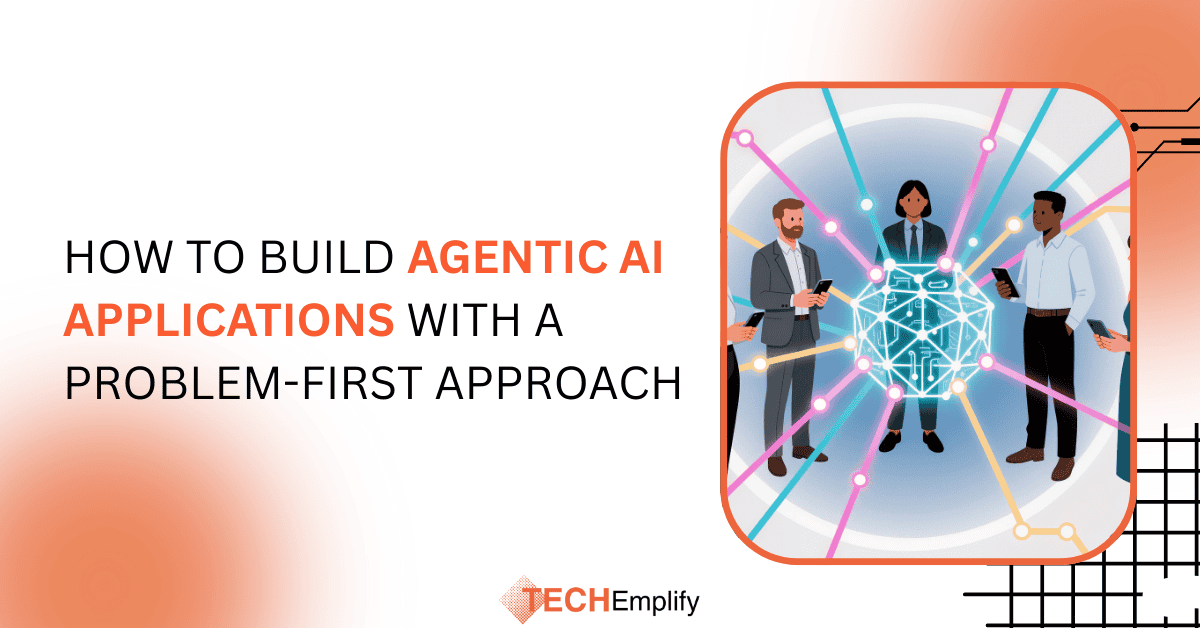
Artificial Intelligence (AI) has rapidly developed from simple predictive models to highly advanced systems willing to perform difficult tasks on its own. The most demanding developments in this field is agentic AI, where AI applications can perform as intelligent agents that understand problems, make decisions, and take actions to solve them. Creating applications like this requires perfect planning and a clear Strategy. In this guide, we will explain how to build agentic AI applications with a problem-first approach, explore its actual deployment, and define the future of artificial intelligence (AI) in the era of advanced AI agents.
Understanding Agentic AI
Agentic AI refers to AI systems that are built to act automatically with an exact goal in mind. Unlike traditional AI models that only provide predictions or suggestions, agentic AI can take actions, review the results, and adjust strategies to meet objectives. These systems are particularly useful in domains like customer support automation, supply chain management, healthcare scheduling, and personalized digital experiences.
Agentic AI relies heavily on Large Language Models (LLMs), which can process natural language, reason through problems, and generate human like results. By merging LLMs with other AI tools such as decision making structures and tool integrations, developers can create applications that are not just reactive but proactive, solving difficult problems efficiently.
Why a Problem-First Approach Matters
Many AI projects fail because they focus too much on technology more than the problem they aim to solve. The problem-first approach flips this point of view, instead of asking “what can AI do?” we ask “what problem do we want to solve?”
This approach has several advantages:
- Clear Goals: Explaining the problem clearly helps in setting specific goals for the AI system.
- Resource Optimization: Focused problem-solving avoids unnecessary difficulties, saving time and computational resources.
- Improved Accuracy: Understanding the problem, making sure that the AI model is trained with relevant data, improving performance and reducing errors.
- User Centric Design: Solutions are more aligned with actual user needs, increasing adoption and satisfaction.
By starting with the problem, developers can design an agentic AI system that is both powerful and maintainable.
Steps to Build Agentic AI Applications

Creating agentic AI applications includes a number of stages, each belongs to the problem-first philosophy. Here is a structured approach:
1. Define the Problem Clearly
Before writing a single line of code, it is important to identify and analyze the problem.
Ask:
- What results are we aiming for?
- Who are the end users?
- What constraints or limitations exist?
- What data is available to solve the problem?
A well explained problem performs like a blueprint, guiding every upcoming step in the development process.
2. Understand the AI Tools and Models
Once the problem is defined, choose the right tools. Key components for agentic AI include:
- Large Language Models (LLMs): These form the core of agentic AI, enabling understanding and reasoning in natural language. LLMs can process complex instructions, generate outputs, and provide explanations.
- Decision Making Frameworks: These help the AI agent decide the best action based on input and context.
- External Tool Integration: Connecting APIs, databases, and other systems allows the agent to perform real world tasks beyond simple computation.
For example, LLMs can act as planners while integrated tools execute the plans, resulting in a fully autonomous agent.
3. Design the Agent’s Workflow
The agentic AI system should have a clear workflow for handling tasks. This includes:
- Input Processing: The agent receives and interprets user requests or data inputs.
- Reasoning: Using LLMs and embedded logic, the agent identifies possible actions.
- Decision Making: The agent selects the most suitable action based on the problem context.
- Action Execution: The selected action is executed through tools or APIs.
- Feedback Loop: The system evaluates the results and updates its strategy for future actions.
A well designed workflow ensures that the agent performs efficiently and improves over time.
4. Data Collection and Preparation
Data is the backbone of any AI system. For agentic AI:
- Gather relevant data: Focus on data that 100% relate with the problem.
- Clean and preprocess: Remove conflicts, handle missing values, and structure data for model training.
- Evaluate data quality: make sure accuracy and reliability; poor data leads to poor decisions.
High quality data improves the agent’s analytical and judgment skills, making it more effective in real world applications.
5. Implement and Train the Model
With the problem defined, tools selected, and data prepared, the next step is implementation:
- Integrate LLMs with workflows: This allows natural language understanding and judgment
- Define agent policies: Set rules for decision making, constraints, and fallback strategies.
- Train on problem specific data: Fine tune models if necessary to improve performance.
- Test with real scenarios: Replicate practical tasks to verify the agent behaves as expected.
Repeated cycles make sure that the agent becomes smarter and more capable over time.
6. Evaluate and Monitor
Evaluation is difficult for agentic AI applications:
- Performance Metrics: Measure success using related stats (accuracy, task completion rate, efficiency).
- User Feedback: Monitor user interactions to identify issues or improvements.
- Safety and Reliability Checks: Ensure the agent follows ethical guidelines and does not make harmful decisions.
Monitoring also helps identify shifts in the AI model’s behavior, which can occur as new data or issues come up.
Integrating Google AI Model and LLMs

Google AI models provide advanced LLM capabilities that can be leveraged for agentic AI. These models are trained on large datasets and are capable of:
- Understanding natural language across various domains
- Logical thinking and planning to solve difficult works
- Integrating with APIs and workflows to perform actions automatically
By using Google AI models, developers can build agents that scale efficiently and maintain high performance across different tasks and domains.
Benefits of a Problem-First Approach in AI Development
- Efficiency: Avoids wasting resources on irrelevant model features.
- Clarity: Ensures all team members understand the objective.
- Better Model Performance: Focused training on problem-specific data improves predictions and actions.
- Sustainability: Easier to maintain and scale the AI system as requirements evolve.
This approach ensures that the AI agent is not just technically advanced, but also practical and user focused.
Challenges to Consider
Even with a structured approach, agentic AI applications face challenges:
- Data Limitations: Insufficient or biased data can reduce effectiveness.
- Complex Decision Making: Multi step tasks may require expert level judgment.
- Integration Issues: Connecting with external tools or APIs can be complex.
- Monitoring and Safety: Autonomous agents must be constantly supervised to prevent undesired outcomes.
Addressing these challenges early in the design phase helps create durable and efficient AI models
The Future of Artificial Intelligence
The future of artificial intelligence is closely tied to agentic AI. As LLMs and AI tools advance, we can expect:
- Autonomous multi agent systems that collaborate to solve complex problems.
- Personalized AI assistants that adapt to individual user needs.
- Enhanced decision making in business, healthcare, logistics, and creative industries.
- Ethical AI frameworks integrated into agent design for responsible automation.
By following a problem-first approach, developers can create AI applications that are not only technically advanced but also socially and economically impactful.
Conclusion
Building agentic AI applications requires more than technical skills, it requires a clear understanding of the problem, the right tools, and a structured workflow. By using LLMs, Google AI models, and integrating external tools effectively, developers can create agents that autonomously solve problems and improve over time.
The problem first approach ensures that AI applications are relevant, efficient, and user centric. As AI continues to evolve, agentic applications will play a pivotal role in shaping the future of artificial intelligence, offering innovative solutions across industries.